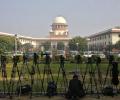
A nine-judge Supreme Court bench has commenced hearing on petitions related to discrimination against women at religious places, including the Sabarimala temple, and the scope of religious freedom across faiths.

Karnataka Chief Minister Siddaramaiah has called for the establishment of a Supreme Court bench in South India to improve accessibility to justice. Speaking at a conference on Artificial Intelligence in the judiciary, he also highlighted the need to address algorithmic bias and ensure judicial independence in the age of AI.
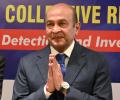
The remarks were made by the bench which refused to agree with the submission made on behalf of Justice Varma that the deputy chairman of Rajya Sabha had no power to reject a motion and, under the Judges (Inquiry) Act of 1968, only the Speaker and the chairman have the power to accept or reject a motion against a judge.
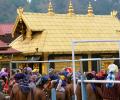
The Supreme Court of India questioned the Centre regarding the eligibility of non-devotees to challenge the customs of the Sabarimala temple in Kerala, during a hearing on religious freedom and discrimination against women at religious sites.

The Centre has informed the Supreme Court that the restriction on women of menstruating age entering Kerala's Sabarimala temple is a matter of religious faith and denominational autonomy, falling outside the purview of judicial review. Solicitor General Tushar Mehta argued that courts should not apply 'secular standards of reason' to religious practices.

Chief Justice of India Surya Kant cautioned against the uncritical adoption of AI in the judiciary, emphasising the need for human judgement and ethical considerations in judicial decision-making.
Chief Justice of India Surya Kant has cautioned against the uncritical adoption of Artificial Intelligence in the judiciary, emphasising the need to balance technological advancements with human intellect and ethical considerations.

The Supreme Court is reviewing the detention of climate activist Sonam Wangchuk after his wife, Gitanjali J Angmo, alleged that key video evidence used to justify his detention was not properly presented to him.
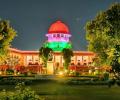
The Centre has asked the Supreme Court to reconsider its judgements decriminalising adultery and same-sex relationships, arguing they were based on a subjective application of 'constitutional morality'.
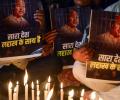
The Supreme Court addressed concerns regarding the detention of climate activist Sonam Wangchuk under the National Security Act, examining his health and the grounds for his detention.
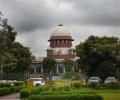
The Supreme Court denied bail to activists Umar Khalid and Sharjeel Imam in the 2020 Delhi riots conspiracy case, citing prosecution material suggesting their involvement in planning and strategic direction. The court granted bail to other activists but emphasized the seriousness of the allegations against Khalid and Imam.

The Delhi police vehemently opposed the bail pleas of activists Umar Khalid, Sharjeel Imam and others in the February 2020 riots case, saying it had become a trend now for doctors and engineers to engage in anti-national activities. The police cited inflammatory speeches and violent protests as reasons for opposing bail.

Customs duty cannot be levied on electricity supplied from a special economic zone (SEZ) to the domestic market, ruled the Supreme Court on Monday while upholding Adani Power's appeal against a 2019 judgment of the Gujarat high court. The 2019 judgment had denied relief to Adani Power from Customs duty on electricity supplied from its Mundra SEZ unit to the domestic tariff area (DTA).
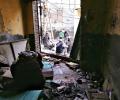
The Supreme Court has directed lawyers for the accused in the February 2020 Delhi riots to restrict their oral arguments to 15 minutes, emphasizing the need for a time schedule. The court also addressed bail pleas from activists like Sharjeel Imam and Umar Khalid, while the Delhi Police maintained the riots were a pre-planned attack.
Lok Sabha Speaker Om Birla admitted a notice for the removal of High Court judge Justice Yashwant Varma and constituted a three-member committee to probe charges against him.
The Supreme Court is reviewing the detention of climate activist Sonam Wangchuk under the National Security Act, considering his health condition and allegations of inciting unrest in Ladakh.
The Supreme Court of India has ruled that an 'act of terror' under the Unlawful Activities (Prevention) Act (UAPA) includes planning, coordination, and mobilization, not just the final execution of the act. The court emphasized that the intent and effect of the act are crucial, not solely the instrumentality used.

The Supreme Court on Friday adjourned to September 22 the hearing on bail pleas of activists Umar Khalid, Sharjeel Imam, Gulfisha Fatima and Meeran Haider in the Unlawful Activities (Prevention) Act (UAPA) case related to the alleged conspiracy behind the February 2020 riots in Delhi.
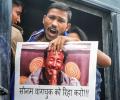
The Centre and the Union Territory of Ladakh administration have accused jailed climate activist Sonam Wangchuk of attempting to instigate Gen Z for protests, drawing parallels to unrest in Nepal, Bangladesh, and the Arab Spring.
The Supreme Court is scheduled to hear a plea challenging the detention of climate activist Sonam Wangchuk under the National Security Act (NSA). The plea, filed by Wangchuk's wife, argues the detention is illegal and violates his fundamental rights.
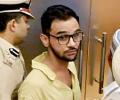
The Supreme Court has refused to grant bail to activists Umar Khalid and Sharjeel Imam in the 2020 Delhi riots conspiracy matter, citing a prima facie case against them under the UAPA. However, bail was granted to other activists in the same case.

A case has been registered against the founder of Ola Electric and other senior officials following the suicide of an engineer who accused them of harassment and non-payment of dues.
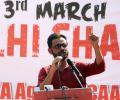
The Supreme Court on Monday sought the Delhi police's response on the bail pleas of activists Umar Khalid, Sharjeel Imam, Gulfisha Fatima and Meeran Haider in the UAPA case related to the alleged conspiracy behind the February 2020 riots in Delhi.
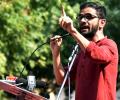
Activist Umar Khalid seeks bail in the UAPA case related to the 2020 Delhi riots, claiming lack of evidence and denying conspiracy charges. Other activists also argue for bail, citing delays and insufficient evidence.
Delhi Police strongly opposes bail pleas of activists Umar Khalid, Sharjeel Imam, and others in the February 2020 riots case, claiming it was a pre-planned attack on the nation's sovereignty and an attempt to divide society on communal lines.

The FIR, filed in December 2022 by M G Nagaraja, alleged that the 24-year-old Paris Olympian, along with his brother Chirag Sen, had fudged their age to get into playing age-group tournaments since 2010.
The Supreme Court on Monday said the right of freedom of speech and expression was being 'abused' while hearing the plea of a cartoonist accused of sharing alleged objectionable cartoons of Prime Minister Narendra Modi and Rashtriya Swayamsevak Sangh workers on social media.
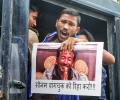
The Supreme Court has sought responses from the Centre and the Ladakh administration regarding the detention of climate activist Sonam Wangchuk under the National Security Act (NSA). Wangchuk's wife has filed a plea challenging the detention, claiming it violates his fundamental rights. The court has given the Centre and Ladakh administration 10 days to respond and has scheduled the next hearing for November 24.
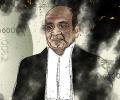
'If the parliamentary committee's report does not find substantiated charges, the process ends.'

The Supreme Court has sought responses from the Centre and Union Territory of Ladakh regarding the detention of climate activist Sonam Wangchuk under the National Security Act. Wangchuk's wife filed a plea seeking his release. The court has scheduled the next hearing for October 14.

The Supreme Court has ruled that a car driver who applies sudden brakes on a highway without warning can be held negligent in the event of a road accident.
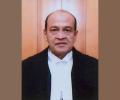
Officials aware of the procedure to appoint and remove Supreme Court and high court judges pointed out that while defending his case before lawmakers in any of the House, Justice Varma can announce that he is quitting and his verbal statement will be considered as his resignation.
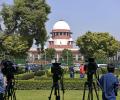
The Supreme Court collegium on Tuesday recommended to the Centre the names of Allahabad high court Chief Justice Rajesh Bindal and Gujarat high court Chief Justice Aravind Kumar for elevation as apex court judges.

The Supreme Court on Tuesday granted protection from coercive action to a cartoonist accused of sharing alleged objectionable cartoons of Prime Minister Narendra Modi and Rashtriya Swayamsevak Sangh workers on social media.
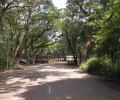
The Supreme Court of India has directed the tree authority of the Brihanmumbai Municipal Corporation to halt any further tree felling in Mumbai's Aarey colony without its permission. The order comes after the Mumbai Metro Rail Corporation Limited (MMRCL) informed the court that there were no pending proposals to cut more trees in the area. The court has previously permitted the felling of a limited number of trees for a metro rail project, but has also imposed penalties on the MMRCL for exceeding its permitted limits.
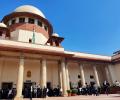
Delhi high court Chief Justice Satish Chandra Sharma, Rajasthan high court Chief Justice Augustine George Masih and Gauhati high court Chief Justice Sandeep Mehta were appointed as top court judges.

"The Union and the state governments must ensure that manual scavenging is completely eradicated," the bench said.

Justices Rajesh Bindal and Aravind Kumar were administered oath during a swearing-in ceremony held in the Supreme Court premises.
The Supreme Court on Tuesday dismissed the argument that a three-judge bench, rather than a two-judge bench, should hear appeals of convicts in the 2002 Godhra train burning case. The court found that the Gujarat High Court commuted the death penalty to life imprisonment, therefore not requiring a three-judge bench. The hearing of the appeals will continue on Wednesday, with the state government seeking restoration of the death sentences of 11 convicts.
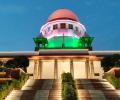
The Supreme Court of India ordered the release of a man who had spent 25 years in prison for murder, ruling that he was a juvenile at the time of the crime. The court found that the convict, Om Prakash alias Raju, had been wrongly convicted due to errors by the courts in determining his age. The case highlights the importance of proper age verification and the need for courts to actively ensure the fair treatment of juveniles within the legal system.
